|
||||
|---|---|---|---|---|
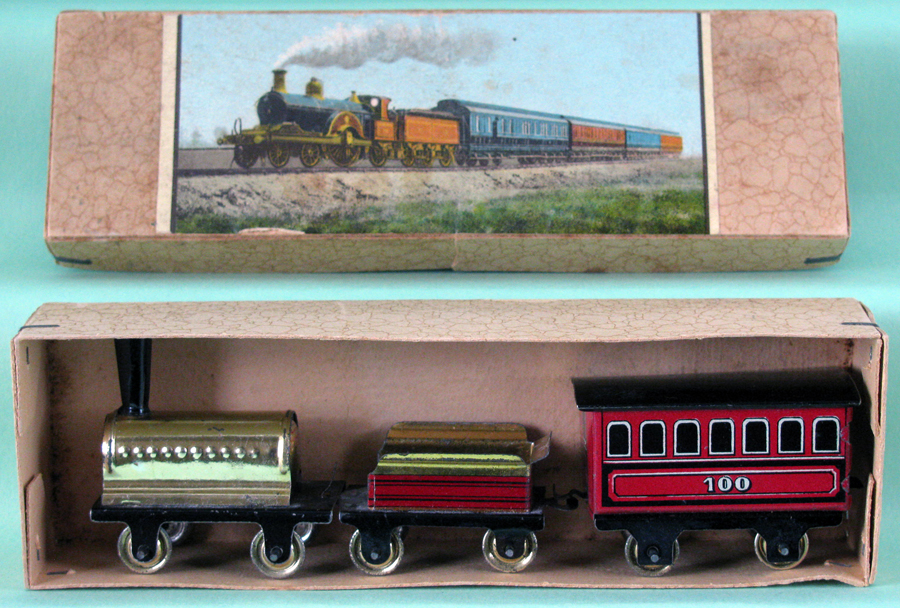
| A Hess boxed set consisting of the old style loco with pasted paper litho on the tender and the new 100 style carriages. Note the difference from the box label to the contents. | ||||
| Hess for Carette 905 (Hess 100) locomotives and rolling stock, circa 1900 Two variations of Hess manufactured locomotives for Carette. Numbered 905 on the locomotives as well as the rolling stock. Note the two different size wheels on the locomotives. Hess made several other size trains for Carette, numbered 906, 907, and 908. Corresponding Hess numbers are 575, 1035, and 300. Other colors of carriages were made as well as freight cars. |
||||
 |
Two early Hess 100 style locomotives and rolling stock. Early passenger cars were numbered with black outline, white centered numerals. Later produced version would use black only serif-type numerals, while the last produced carriages used a very thin, sans-serif numeral. Some versions of these early 100 locomotives had pasted paper litho on the tender. | |||
| A very early Hess 100 style locomotive. Notice that there are but two sets of wheels designed rather than the later three sets, which became a standard on these 100 trains. The only two wheel exception is on the small 100 style loco without tender which you will see later on. Marked with “100” and “MH” (Matthias Hess). | ||||
| A second generation manufacture of the Hess 100 style train. Now using the “JLH” initials as a logo and the solid serif numerals for coaches. Set consists of blue, red, and green passenger coaches and red bodied locomotive. | ||||
| Hess early 100 series 2 axle locomotive marked “M H” (Matthias Hess) As Hess developed their new lithographic line of trains, this very early 2 axle locomotive shows some of the trial and error in developing the product. The two axle locomotive used thicker side rails to strengthen the frame, but apparently was not enough support as Hess went to three axles for this series until the end of production in 1934. The tender is painted but I am unsure whether paper litho was applied as with other early versions. The only other 2 axle locomotives produced in this series were shorter and without tender. The early 3 axle locomotive shown below closely followed in manufacture and is all litho printed.
|
||||